

How to Make CBD Chocolates: a Berkeley Herbal Center Workshop
Willy Wonka meets herbology? Craftsmanship's contributing editor gets a hands-on lesson in making plant medicine, with sweet results.


Dear Friends,
In this “short & sweet” dispatch, which is related to last week’s story on the craft of herbalism, contributing editor Jeff Greenwald offers a peek inside a Berkeley Herbal Center workshop. There, he and other aspiring DIY herbologists melted fine Belgian chocolate with cannabidiol (CBD), and contributed to a lively conversation about plant medicine, healing, and the pleasures of making things yourself.
We hope you’ll enjoy reading, “How to Make CBD Chocolates: A Berkeley Herbal Center Workshop,” by Jeff Greenwald.
We always welcome your thoughts and suggestions, which you can offer in a comment, as a Substack Note, or via email. Thank you for reading and sharing our stories, for supporting our work with a paid subscription if you can, and for being such a loyal part of the Craftsmanship community.
Sincerely,
Todd Oppenheimer
Publisher & Editor-in-Chief, Craftsmanship Magazine
How to Make CBD Chocolates: A Berkeley Herbal Center Workshop
Story by Jeff Greenwald
The Berkeley Herbal Center is a fragrant Brigadoon, tucked among trees and strollers on the edge of Berkeley’s Strawberry Park. Established in 1995, the Center purports to be “one of the few combined herbal schools, clinics, and plant medicine-making locations in the United States.”
As such, they offer frequent classes and workshops, including Weeds as Medicine, herb walks, and An Introduction to Herbalism. To get a hands-on sense of one aspect of the craft, I signed up for a short morning class called CBD Chocolates with Penny Barthel. “Join us to make delicious, custom-dosed CBD chocolate hearts. All equipment and ingredients are included.” What’s not to love?
Penny Barthel, based in the East Bay, is an enthusiastic, highly knowledgeable educator and the co-creator of Wondering About Weed, which she started with her business partner, writer Kaisha-Dyan McMillan. A certified cannabis horticulturist, she recently joined the board of directors for the Berkeley Herbal Center.
“Cannabis is a genuinely fascinating plant,” says Barthel. ”Though I’ve long been enamored with plants in general, I can say with confidence that cannabis is my favorite. I love introducing folks to this plant because I know it offers something to everyone—whether it’s easing pain and anxiety, drifting off to restful sleep, or helping to smooth out the everyday worries we experience. It’s also one of my favorite ingredients to experiment with in the kitchen.”
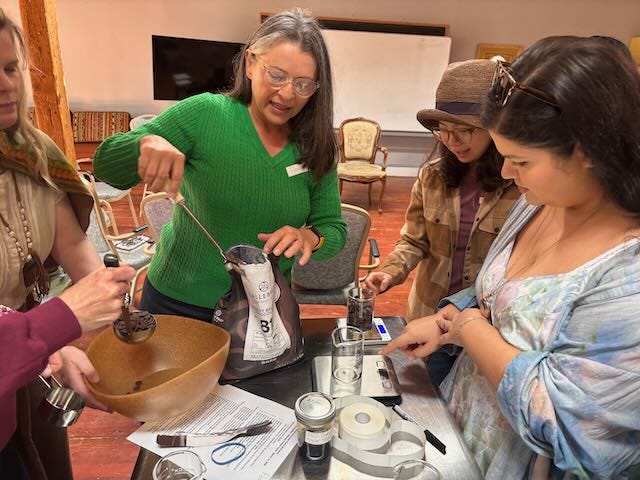
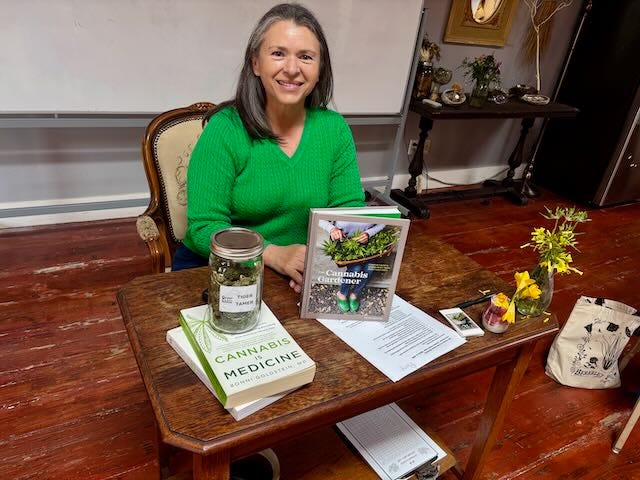
Twelve of us connected in the Center’s classroom: Barthel, myself, and a diverse group of women. Interestingly, during my five visits to the Center I never saw another man—confirming the female-forward relationship with herbology embodied by the character of Anne Hathaway-Shakespeare in the 2025 historical drama “Hamnet.”
Barthel was careful to distinguish between THC (the psychoactive molecule in cannabis) and the miracles of the cannabidiol molecule (CBD), which “offers soothing aid to the body mood without the high.” As someone who dislikes the THC high, this was a big selling point. And though I’m not one of those people whose body is “notably soothed by CBD,” I bit into the experience with that old saw I’ve relied on so very many times: It can’t hurt.
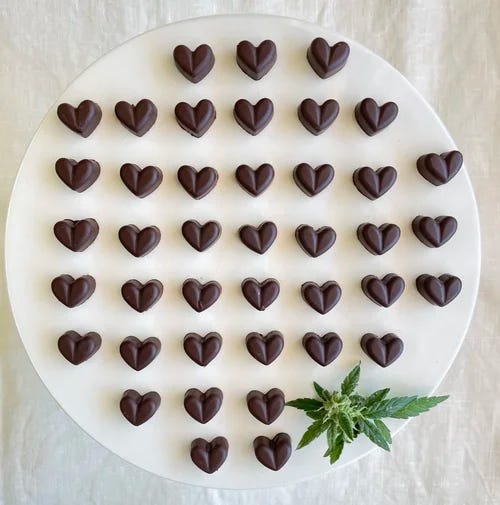
After Penny’s talk (and an exhaustive Q&A), we took our places at our individual work stations and were instructed in the use of our lab equipment—which included a Barbie-pink silicone tray with 50 small, heart-shaped molds.


Our first step was to use jewelers’ scales to precisely measure out 125 grams of dark chocolate (Callebaut 811, a high-end brand from Belgium—Penny doesn’t kid around) into a beaker, and melt it in the Center’s microwave. Next, we chose the dosing we wanted (between 5 mg and 30 mg per heart) and carefully stirred the corresponding amount of Bartel’s pre-formulated CBD concentrate into the melted chocolate.
“Since it doesn’t make you high, the difference in the CBD doses is nothing most people will notice,” says Penny. “Some people will feel calmer with a higher dose, especially if it’s taken over time. Some people will feel less pain, or get spasticity relief.” Because spasticity (bradykinesia) is a side effect of Parkinson’s medications, CBD has been researched to see if it can improve quality of life for PD patients. “And since it is an anti-inflammatory,” Barthel says, “it works very gently over time to relieve arthritis or any kind of inflammatory pain.”


We then returned to our stations and poured the mixture into the 50 pink heart molds. For me, at least, this was the most challenging part of the process: using a little metal trowel to get all those tiny hearts filled (nothing is sadder than an empty heart). Some of the students had even brought colored sprinkles, adding a party look to their hemp-adjacent confections.
Once our heart molds were filled, we transferred them into a refrigerator to cool and harden.
It was a fine introduction to the Berkeley Herbal Center, very breezy and informative. Best of all, I now have a Mason jar full of Callebaut chocolate hearts: Feeling better never tasted so good.
ICYMI…
Herbalism: Crafting Ancient Plant Medicine for Modern Life

Inside the Berkeley Herbal Center, traditional knowledge is thriving—not as a musem relic, but as a living practice focused on holistic healing.
Nest at 20: Building a Future for Global Craft Communities

Nest offers access to the tools, global partnerships, and broader networks that help artisans build more resilient businesses.
 | A guest post by
|