

The Curious Art—and Origins—of Horsehair Hitching
Artisan Shoni Maulding discusses the mysterious origins of her craft, how she’s found the patience to master this unique art form, and why her work could never be produced by a machine.


The Curious Art—and Origins—of Horsehair Hitching
Nobody’s quite sure where or when the tradition of horsehair hitching began. Perhaps it came from the Moors who conquered Spain, or military leaders during the Ottoman Empire. Spanish sailors, bored on long cross-Atlantic trips, also could have brought the tradition to the Americas, perhaps inspiring craftspeople in Old Mexico.
What is well-documented is the craft’s widespread practice inside prisons of the American West. That’s how Shoni Maulding, a sixth-generation Montana resident and 30-year veteran artisan, first heard of the craft.
“ There are so few people that hitch horsehair that aren't in prison,” says Maulding, who has authored a couple of how-to books on hitching.
No, Maulding herself wasn’t a prisoner. Her husband and creative partner, Ron Maulding, observed prisoners doing it when he was a hobby director at Montana State Prison.
The couple live on the Flathead Indian Reservation, just north of Missoula, Montana. Shoni is part Shoshone, and she says that even though some Native American people have been known to hitch, it’s not an ancestral craft.

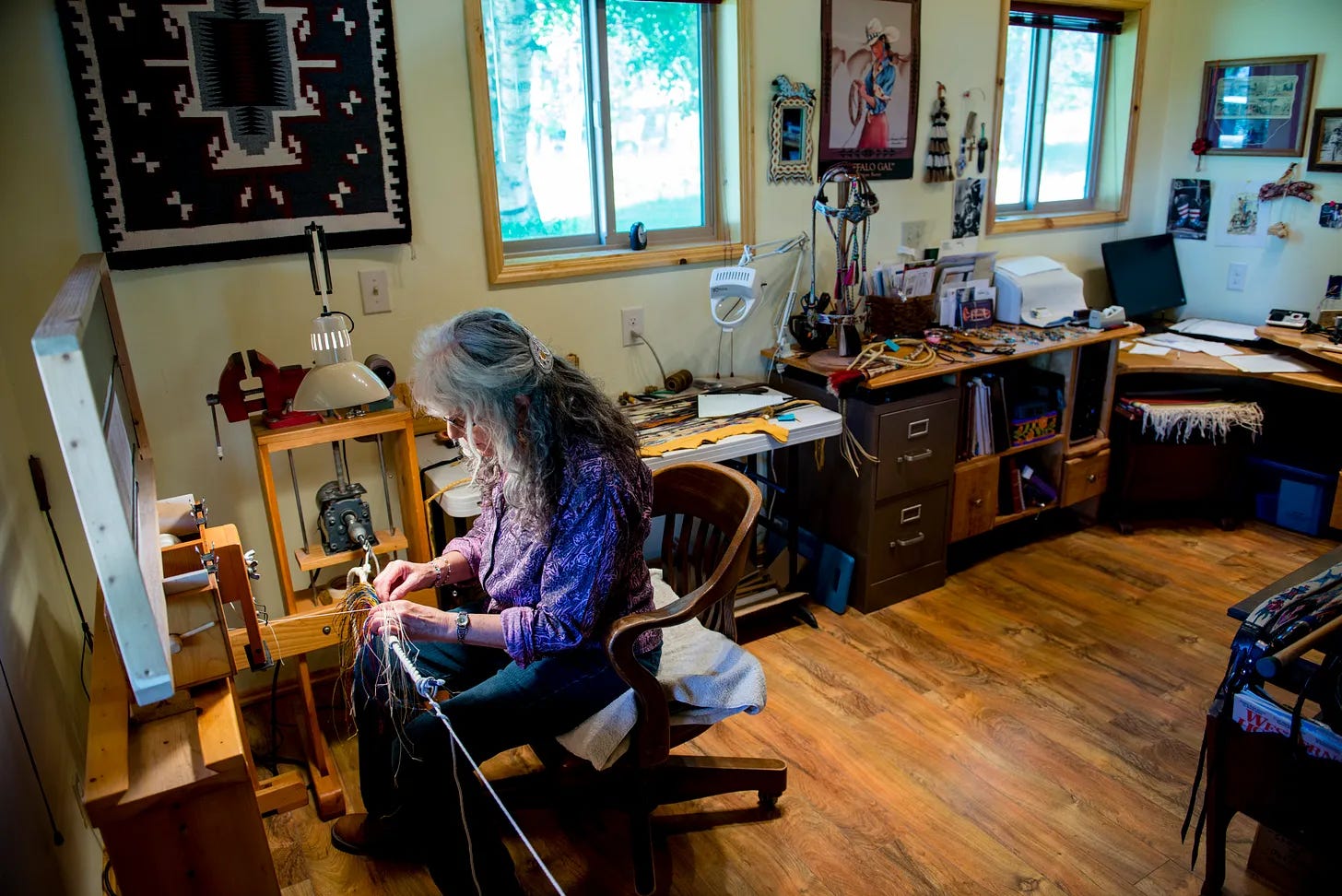
Hitching is much more complex than braiding or tying horsehair: It’s a system of knotting long clusters of at least 10 horse-tail hairs, or “pulls,” into functional pieces, such as belts or bracelets.
To achieve the intricacy that marks Shoni’s designs, it’s not uncommon for her to spend 12 hours a day, for four to six weeks, hitching one piece. The work is so slow, she says, that finishing a 3-inch section in a single day would be an accomplishment worth celebrating: “You know, bells and whistles go off!” Not surprisingly, her products aren’t cheap—a 36-inch belt could cost as much as $1400.
Another way this craft stands apart, Shoni told me, is that there’s no measure of a master horsehair hitcher. She says her patience to hitch for hours on end comes from her fascination with the horsehair itself, and all of its creative possibilities. And while hitching is a solitary endeavor, Shoni feels it has given her a kind of community. She remembers when a customer in Tucson, AZ, asked her to hitch a belt from the hair of his recently deceased horse. She felt deeply touched by how grateful he was for the final product. “ We've made friendships over the years with some of these people,” she says.
On this episode of The Secrets of Mastery, I talk with artisan Shoni Maulding about horsehair hitching’s mysterious origins. You’ll hear more about how she’s found the patience to master this unique art form, and why a machine could never learn to hitch.
“The Curious Art—and Origins—of Horsehair Hitching,” with Shoni Maulding, was hosted and produced by me, Pauline Bartolone. You can listen to it on YouTube, the Craftsmanship website, or wherever you like to get your podcasts, including Apple and Spotify.
ICYMI…

Read: “The Fragility of India’s Artisan Communities,“ by Laura Fraser
India’s communities of specialized artisans—who are often the knowledge-keepers of their centuries-old craft traditions—face an uncertain future.

Read: “My Father’s Mallet,“ by Gary Rogowski
Master woodworker, furniture maker, author, podcaster, and teacher Gary Rogowski offers an "object lesson" from his earliest days of learning the craft.

Craftsmanship Magazine focuses on master artisans and innovators whose work informs our quest: to create a world built to last. In addition to our Substack offerings, you’ll find more stories, podcasts, photo essays, and documentary shorts on our free website—along with community resources like our Artisans’ Directory, our guide to U.S.-based craft & folk schools, and much more.